
Fracture Toughness Test for Industrial Applications
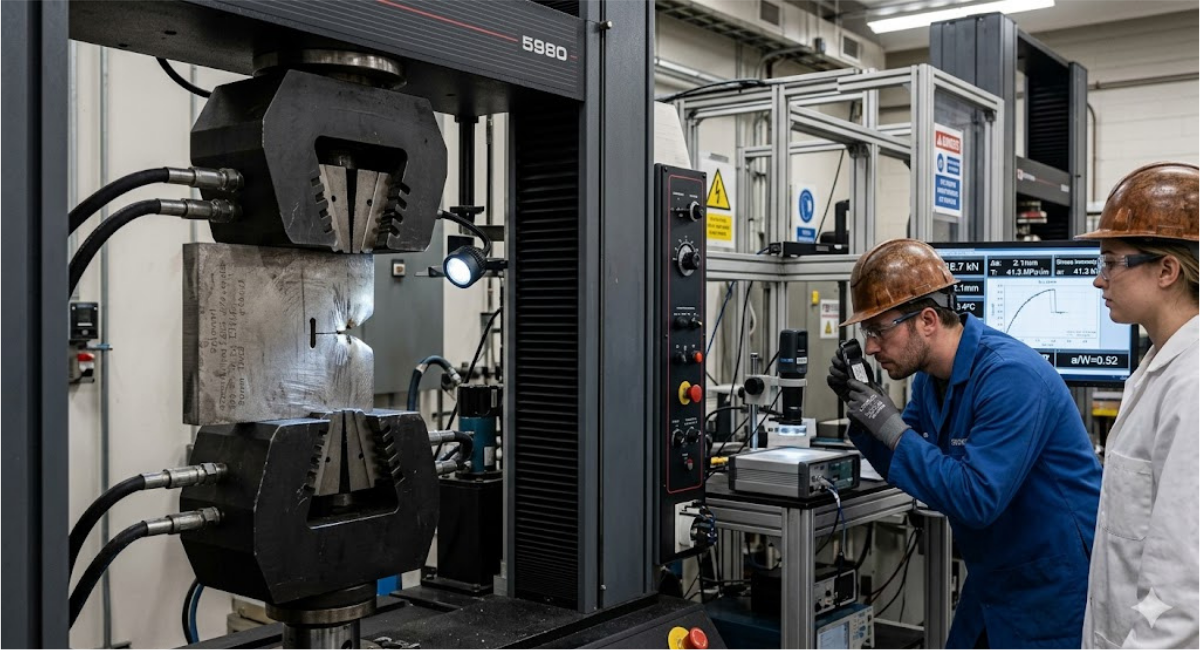
Fracture Toughness Test for Material Strength & Structural Integrity
Fracture Toughness Test for Material Strength & Structural Integrity is carried out to see how a material reacts when a crack already exists inside it. In actual components, microscopic flaws may develop during welding, forming, or long-term service. The real question is whether that crack will stay stable under load or suddenly extend. This test helps engineers understand that behavior instead of assuming the material will perform safely.
In the laboratory, a notched sample is prepared and loaded gradually under controlled conditions. As the force increases, the crack tip experiences high stress concentration, and its growth resistance is measured. From site experience, materials with good tensile strength do not always show good fracture resistance, which is why this test is separately required. The data obtained supports safer design decisions for pressure vessels, pipelines, and structural frameworks where unexpected fracture is simply not acceptable.
What is Fracture Toughness Test and Why is it Important?
Fracture Toughness Test is done to understand how a material handles stress when a crack already exists inside it. In real fabrication work, achieving a 100% defect-free structure is almost impossible. Small flaws from welding, forming, or long service exposure can remain within the metal. The test helps determine whether such a crack will remain stable or start spreading when the component is loaded.
This becomes important because strength alone does not tell the full story. There have been situations in industry where parts met tensile requirements but still fractured without much warning. Fracture toughness values give engineers a better idea of crack resistance under actual working stress. In simple terms, it adds an extra layer of safety while designing pressure vessels, pipelines, and other load-bearing structures.
Importance of Fracture Toughness Test in Structural Engineering
Fracture Toughness Test is often discussed during material approval stages, especially for thick plates and critical welded joints. On paper, a steel grade may fully satisfy yield and tensile strength requirements. However, real structures are not perfect; small discontinuities can remain even after inspection. The concern is whether those flaws will stay stable or extend when the structure is subjected to load.
Field observations over the years have shown that some failures were not due to low strength, but due to poor crack resistance. A component can carry load comfortably and still fracture suddenly if toughness is insufficient. That is why fracture toughness values are reviewed separately in many structural specifications. It gives engineers a more realistic understanding of material behavior under stress concentration
From a practical design angle, this test supports better decisions in bridge members, heavy industrial sheds, crane structures, and similar applications. It helps in assessing welding procedures and selecting suitable material grades. While it may appear as just another test parameter, in long-term service conditions it plays a meaningful role in improving structural reliability and reducing unexpected brittle failure.
Applications of Fracture Toughness Test in Critical Industries
Pipes, boilers, tanks — they all operate in conditions that are far from perfect. Tiny cracks can appear here and there, maybe from welding or just regular wear and tear. The thing is, not every crack causes a problem immediately. But some cracks can grow over time and suddenly cause failures, and that’s obviously dangerous. That’s why engineers rely on the Fracture Toughness Test. It helps them understand how a material behaves when there’s already a small crack — basically, how much punishment it can take before it fails.
Take aerospace, for example. Aircraft parts are subjected to repeated take-offs and landings. Even a small imperfection in a wing or landing gear can expand if the material isn’t tough enough. Cars, too, especially the structural parts, need similar checks. In an accident, you want the metal to bend or absorb energy, not just snap. Fracture toughness values give designers a practical way to predict that. It’s not just about what the material’s certificate says, it’s about real-life performance under stress.
Why Choose Our Lab for Fracture Toughness Test?
Some just run the test, hand over a certificate, and that’s it. That doesn’t really help in real-world situations. In our lab, we look at what the results actually mean for your materials. We’ve handled metals, alloys, and composites used in airplanes, cars, and power plants, so we know what to watch for. It’s not just numbers — it’s insight that you can use.
We also take care of small but critical details. Tiny cracks, small temperature changes, variations in stress — all these can make a difference. Most labs ignore these, but we don’t. That way, the results you get are realistic and actually useful for your design, maintenance, or safety decisions. Plus, waiting for reports is frustrating, we get that. We deliver quickly and explain them clearly, so you actually understand what the numbers mean. People come to our lab because they want more than just data — they want advice, guidance, and confidence that the material will behave as expected in the real world
Get Reliable Fracture Toughness Test for Long-Term Performance
Take oil and gas pipelines, for example. They work under high pressure, sometimes extreme heat, and even small vibrations. Tiny cracks can appear over time. If no one checks them, they grow and then… well, it’s a big problem. This test basically shows how the material behaves when it already has flaws. It’s not just a number; it’s like a reality check for the material.
In aerospace and cars, it’s similar. Aircraft wings, landing gears, engine parts — they face repeated stress all the time. Cars also have safety-critical parts that need to survive impacts. Materials with good fracture toughness resist cracking, even if there’s a tiny defect. Engineers use this info to decide what’s safe.
Ensure Your Materials Perform Safely
Share your requirement today and get expert guidance on the right test plan for your materials.

